
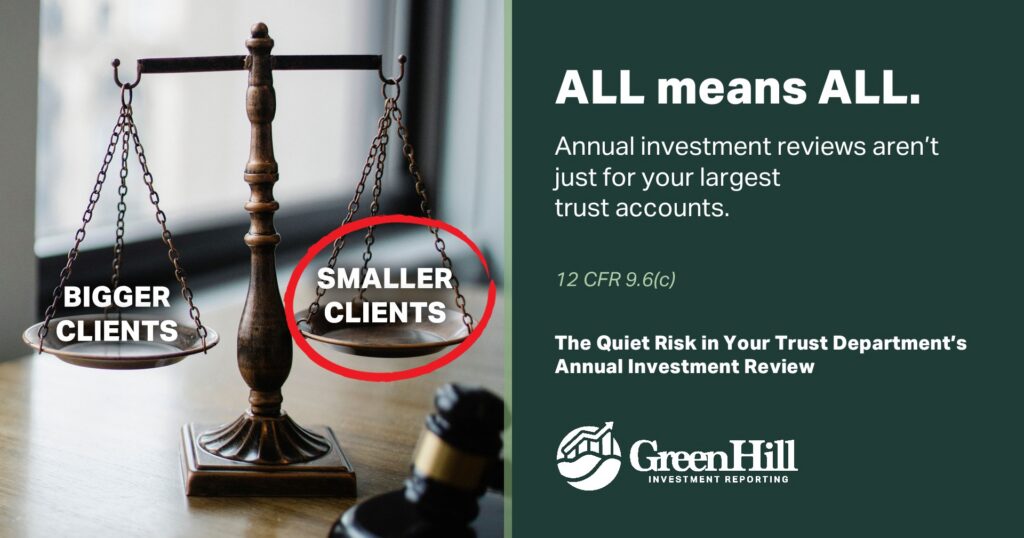
Most bank trust departments conduct annual investment reviews. Fewer are confident that those reviews would withstand a hard look from an examiner, or from a beneficiary’s attorney.
The gap between the two is rarely a matter of intention. It is almost always a matter of coverage and documentation. And it is a gap that regulators are increasingly equipped to find.
What the regulation actually says
Under 12 CFR 9.6(c), national banks are required to conduct a review of all assets of each fiduciary account for which the bank has investment discretion at least once during every calendar year. The OCC’s own guidance specifies that this process should include performance measurements and a documented process for handling performance outliers.
This is not aspirational language. It is a regulatory requirement with examination consequences. And the key word is all — not most, not the ones above a certain asset threshold, not the ones whose beneficiaries are most likely to ask questions. All.
The Federal Deposit Insurance Corporation reinforces this, including annual investment reviews as a minimum requirement for the sound operation of a trust department. The Federal Reserve views them as an indicator of sound fiduciary management. The message from every major bank regulator is consistent: the annual investment review is not a courtesy. It is a baseline expectation.
The assumption that creates exposure
There is a common and understandable assumption in the trust industry that smaller accounts do not require the same level of investment performance oversight as larger ones. The reasoning is intuitive: beneficiaries of smaller accounts are less likely to ask about performance, less likely to engage legal counsel, and less likely to generate scrutiny that warrants a full performance review infrastructure.
The flaw in this reasoning is that it confuses client engagement with regulatory obligation. Performance reporting is not primarily a client communication tool. It is an internal fiduciary oversight mechanism. Examiners evaluate the bank’s process, not whether clients have requested information.
The assumption also gets the litigation risk backwards. Smaller accounts tend to generate more beneficiary disputes, not fewer. The incremental cost of a beneficiary dispute — legal fees, potential settlement, management distraction, reputational impact — almost always exceeds the cost of the monitoring that would have surfaced the issue earlier.
What examiners are asking
The questions regulators are bringing to examination cycles have become more specific. Trust departments are increasingly being asked to demonstrate not just that annual reviews occurred, but how investment results are assessed across all discretionary relationships, what process exists for identifying underperformance in accounts that are not actively monitored, and how the institution evaluates whether fiduciary objectives are being met in accounts that lack documented performance results.
These are not questions that can be answered with a general policy statement. They require evidence: account-level documentation, consistent methodology, exception tracking, and an audit trail that connects reported results to source data and investment policy standards.
The practical implication
A trust department that monitors performance consistently across its full book of discretionary accounts — with documented methodology, benchmark governance, and exception tracking — is not just better positioned for examination. It is operating a proactive risk management program that can identify problems before they become complaints.
The technology to do this is more accessible and more cost-effective than many institutions realize. The question is no longer whether comprehensive performance monitoring is achievable at scale. It is whether your institution has made it a priority before an examiner makes it one for you.
GreenHill Investment Reporting has served bank trust departments and fiduciary institutions since 1991. To learn more about our performance reporting capabilities for bank trust, visit ghill.com or contact us at sales@ghill.com.