

Accurate and timely investment performance reporting is a critical part of successful investing. It allows investors to track the performance of their portfolios and assess the success of their investments over time. Without accurate and timely reporting, investors would struggle to accurately measure the success or failure of their investments, making it difficult to make informed decisions about their portfolio.
With GreenHill as your independent performance measurement partner, you can leverage our expertise in preparing and presenting performance for your client’s investment accounts. The added objectivity of an independent third-party enhances the value of performance reports delivered to your clients. ReportQuest, our online client portal, provides resources for production reporting, ongoing maintenance and detailed performance research and analysis.
Choose from a broad menu of tables and graphs to design performance presentations tailored to client situations.
Schedules cover time and dollar weighted returns, asset growth, asset allocation and investment objective comparisons.
Customize benchmark assignments and blend benchmarks at the total fund and segment levels.
Organize and build client relationship and firm wide composites.
Analyze risk, sector attribution and security level performance.
Create a unique asset mapping scheme to provide performance for desired asset groups and sub-groups.
Our Investment Performance Reporting offers a suite of robust tools designed to enhance your investment analysis and decision-making processes. With features like risk analysis, sector attribution, and security-level performance evaluation, you gain deeper insights into the factors influencing your portfolio’s returns. Our customizable asset mapping allows for tailored performance assessments across various asset groups and sub-groups, ensuring that your reporting aligns with your specific investment strategies. By partnering with GreenHill, you benefit from a comprehensive, flexible, and detailed performance reporting system that empowers you to make informed investment decisions with confidence.
Our feature-rich online performance reporting solution streamlines the way you organize, analyze, and prepare your client investment reports.

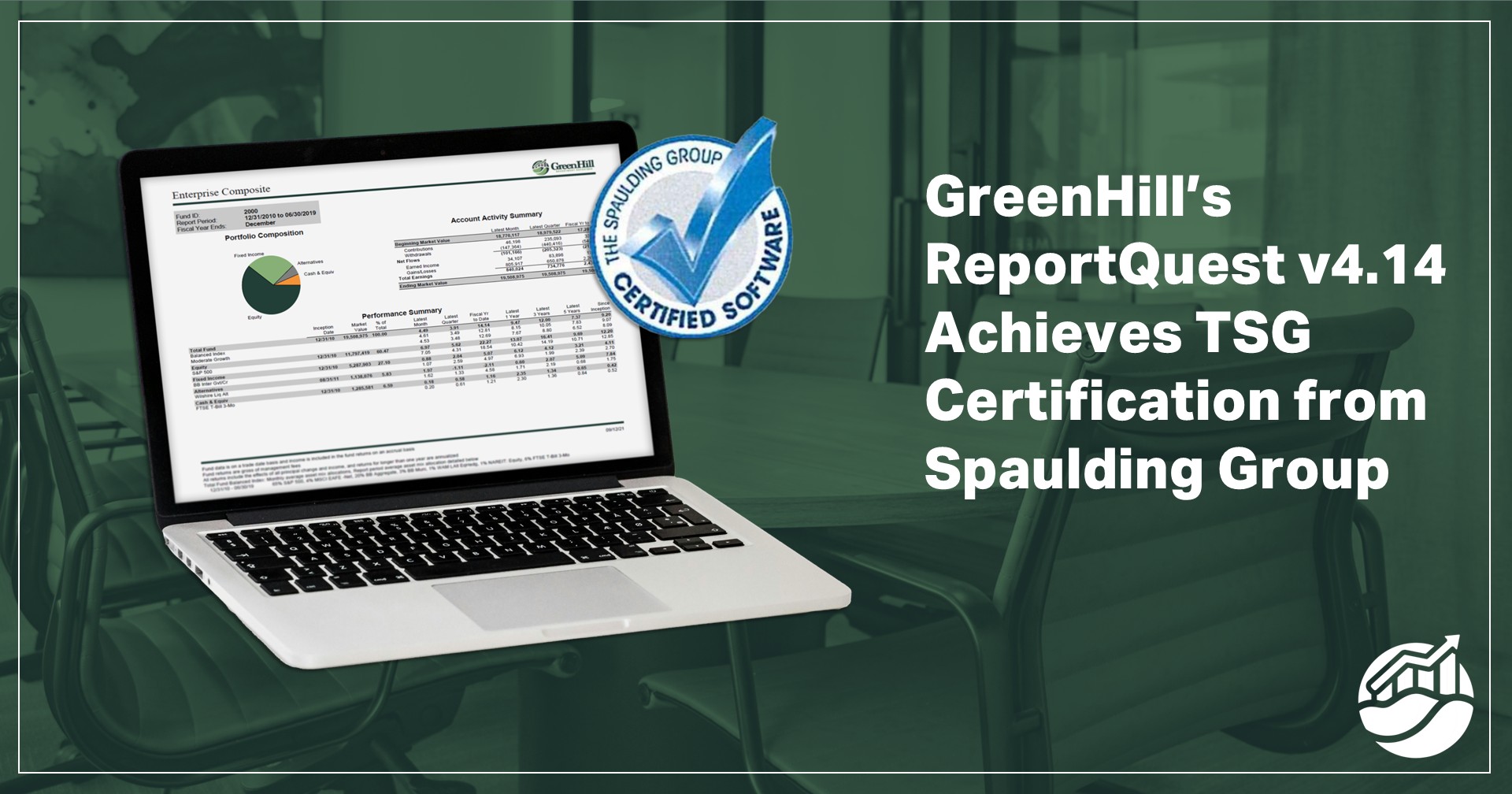
ReportQuest v4.14 has officially been TSG Certified by The Spaulding Group, a recognized authority in investment performance and risk measurement. This independent review confirms that our rates of return calculations meet a rigorous set of extensive criteria across functionality, accuracy, controls, usability, reporting, and more.
Performance reporting measures how an investment portfolio has performed over a defined period, typically using time-weighted or money-weighted returns.
Time-weighted return removes the impact of cash flows and shows the manager’s skill. Money-weighted return (also known as IRR) measures the actual investor experience and is influenced by cash flow timing.
Accurate reporting builds trust, satisfies fiduciary obligations, supports investment decisions, and helps advisors explain results to clients and committees.
Common root causes include incorrect security prices, missing corporate actions, incomplete cash flows, custodian feed issues, benchmark mismatches, and improper mapping of asset segments.
Benchmarks provide context for performance results by comparing the portfolio to an appropriate market index or blended index that reflects the portfolio’s risk and asset mix.
Contribution analysis identifies which securities, sectors, or segments added to or detracted from total portfolio performance, and by how much.
Attribution explains why the portfolio performed the way it did (for example allocation effects versus security selection effects).
Variance analysis compares account results to a selected comparator such as a benchmark or model to identify outliers or unusual performance patterns.
Poor data quality leads to incorrect performance results, compliance risk, and loss of client confidence. Reliable reporting depends on accurate security prices, correct share balances, and complete transaction histories.
Blended benchmarks are used when a portfolio has multiple asset classes or strategies that cannot be fairly compared to a single market index.
Regulators expect accurate and transparent reporting because trustees and fiduciaries must act in the best interest of beneficiaries and clients. Weak reporting increases operational and fiduciary risk.
Most institutions report monthly or quarterly. High frequency reporting may be necessary for internal oversight or more dynamic portfolios.
Common challenges include limited technology, high per account costs, lack of benchmarking support, examiner expectations, and difficulty producing consistent reporting for all discretionary accounts.
Different clients require different levels of detail, different time periods, and different benchmarks. Customization supports stronger communication and better investment discussions.
Clear, accurate, and contextualized reporting builds long term trust and helps advisors demonstrate value during both good and difficult market periods.